
Passing a Family Vault to the Next Generation — Without a Custodian
Digital inheritance is on the political agenda. How a 2-of-3 multisig lets a family inherit Bitcoin — zero platform keys, no single point of failure.

Digital inheritance has quietly moved from a private worry to a public debate. In the Netherlands, MP Barbara Kathmann — of PRO (formerly GroenLinks-PvdA) — has been pushing for a national awareness campaign after more than eight in ten people, by her account, have made no arrangements at all for their digital estate. Her examples are ordinary and painful: families locked out of a loved one's accounts, and next of kin who cannot reach the crypto of someone who has died — bureaucracy landing on people in the middle of grief.
It is a good moment to talk about the hardest version of that problem, because it is the one most people get wrong. Not "who gets the online photos," but: how does a family actually inherit Bitcoin?
Why Bitcoin is the hardest case
Most of what we own is inherited through an institution. A bank account, a brokerage, a pension — someone can call the provider, show a death certificate, and the asset moves. There is a company in the middle whose job is to hand it over.
Bitcoin can be held that way too. Coins on an exchange, or exposure through a spot ETF, sit inside a company with a documented estate process — death certificate, probate, executor identification — after which the position transfers or is liquidated. Someone holding a spot ETF inherits Bitcoin much as they would inherit an index fund. Held directly, though, Bitcoin is a bearer asset: whoever controls the keys controls the coins, and nobody else can move them or recover them. That is what self-custody means — and it is exactly what makes inheritance unforgiving.
So the real decision comes before any of the mechanics: every inheritance arrangement is a choice about which failure mode you accept. A custodian genuinely removes the operational ones — lost seeds, backups nobody can find, heirs with no idea what to do — and gives your family a legal claim that survives the total loss of every credential you ever held. The price is a counterparty: whoever can move your Bitcoin for you can also freeze it, be compelled to hand it over, or fail and leave your heir standing as an unsecured creditor — and over a horizon measured in decades, that company may simply not be there. Self-custody multisig removes the counterparty and hands you the operational burden instead. Neither is free, and neither is wrong for everyone: the counterparty risk grows with your balance and with the years, while the operational work is roughly the same whether you hold a little or a lot. This article is for the people for whom the second trade is the right one, and from here it assumes that choice is made.
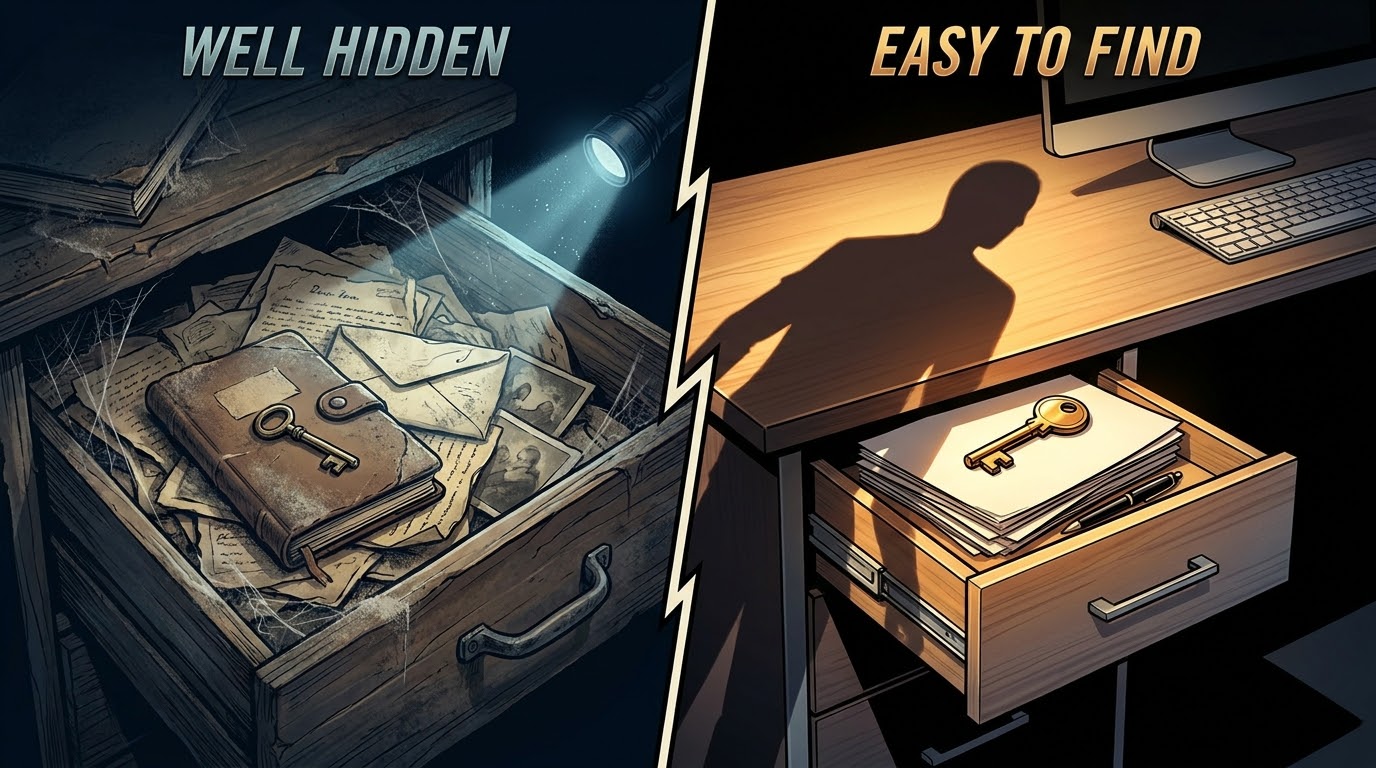
A seed phrase written on paper and left in a drawer has two failure modes, and they pull in opposite directions. If it is easy enough to find that your family will find it, it is easy enough that a visitor, a contractor, or a burglar can find it too — so it leaks. If you hide it well enough that nobody can steal it, you have also hidden it well enough that your family may never locate it — so it is lost forever. Every single-key inheritance plan is a bet about which of those two failures you can avoid.
There are real mitigations. A BIP-39 passphrase splits the secret from its location — seed somewhere findable, passphrase with a solicitor; Shamir backups (SLIP-39) cut a secret into shares spread across people and places; a sealed instrument left with a notary carries professional duties that a friend with an envelope does not. Each of these works, and each adds another secret to maintain for as long as you hold. None is enforced by anything stronger than people honouring an arrangement.
The informal version — write the seed on a card, seal it in an envelope, tell one person where it is — doesn't remove the problem at all. It hands the single point of failure to someone else, who can drain everything today, while you're alive. I spent time earlier in my career on a Bitcoin inheritance product, and this is the wall every honest design hits. Even splitting the key doesn't get past it: Shamir's shares have to come back together on one device, at one moment, in front of one person — the exact exposure the scheme was meant to remove. To get inheritance without that moment, you need a different shape, one enforced by the coins rather than by an agreement.
The multisig answer, in plain language
That shape is multisig — specifically a 2-of-3 setup, which is the sweet spot for families.
Picture a vault with three separate locks and three separate keys, where any two keys will open it. You hold two of them — say, one at home and one somewhere else. A third lives with a person or place you trust. To move funds, someone needs any two of the three. That third holder doesn't have to be nearby, or even on the same continent: you invite them, and once they accept they add their own key from their own device, so you never handle their seed or their hardware. They don't need a paid account either — they take part at no cost, scoped to that one vault.
Two properties fall out of that arrangement, and together they solve the drawer problem:
- No single key can move the money. If one key is stolen, photographed, or quietly copied, the thief cannot move the funds — one key is not enough. Two things do still happen. A leaked key discloses the public key behind it, and whoever ends up holding all three public keys can read the vault's entire balance and history — so a leak costs you privacy even when it cannot cost you coins. And the theft silently drops a 2-of-3 to an effective 2-of-2, with nothing announcing it. The coins stay put; the setup still needs repairing. So keys no longer have to be hidden perfectly — they have to be distributed sensibly, and a compromise has to be noticed.
- No single lost key loses the money. If one key is destroyed in a fire, forgotten, or buried with someone, the remaining two still open the vault. No single object's loss is fatal — but the margin is exactly one. The generational failure isn't dramatic; it's silent and sequential. A key stops working, nobody notices, and years later a second one fails. The protection is real, and it holds only if somebody is checking that all three still work.
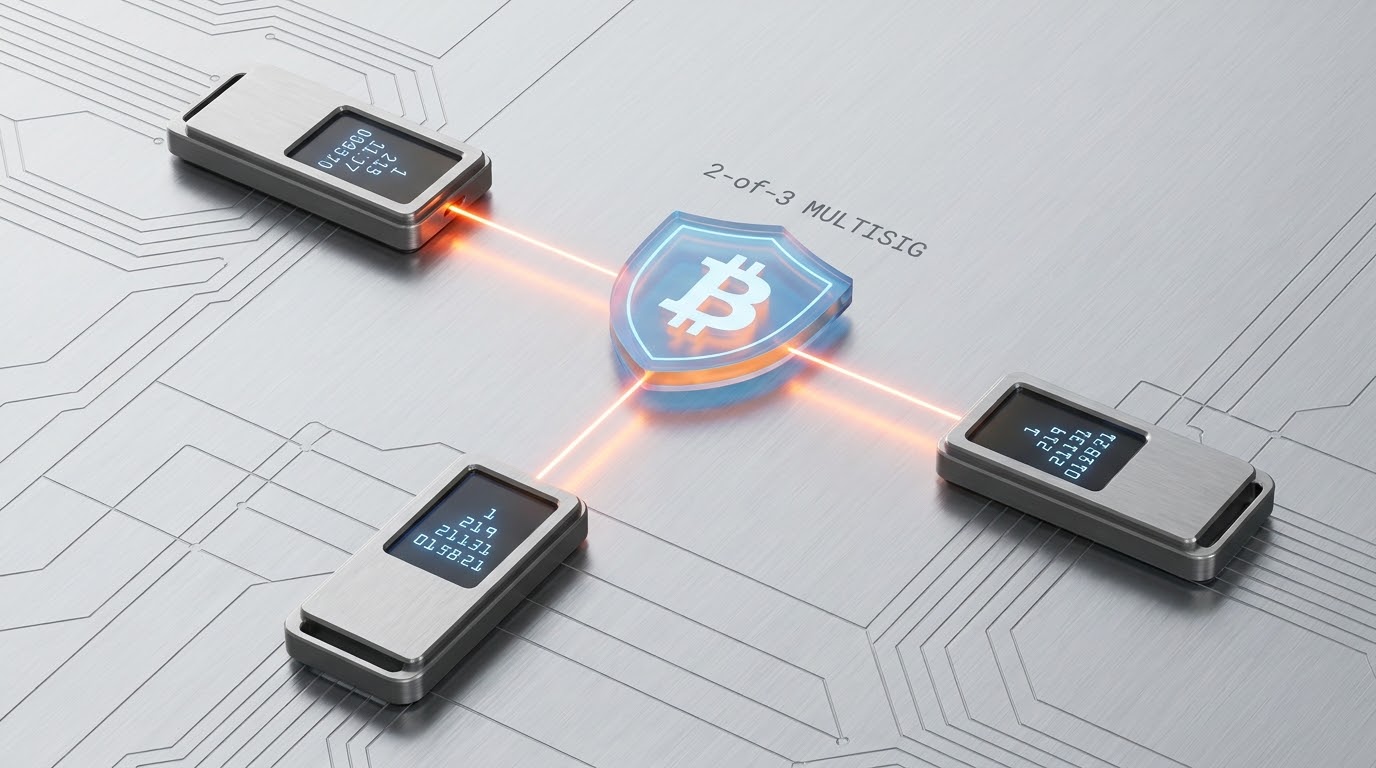
One caveat, because it is the most common way a 2-of-3 turns out weaker than it looks: the guarantee assumes the three keys fail independently. Three keys made by the same person, on the same vendor's hardware, in the same room, and stored in the same building share a firmware supply chain, a procedure, a burglar and a fire. Independence gets built on purpose — different vendors, different locations, different people — which is why Keystody supports Ledger and Trezor natively.
For inheritance, the second property is the one that changes everything. Your heirs do not need to be Bitcoin experts today. They do not need to be handed a secret while you're alive. They need to end up, at the right moment, able to bring together two of the three keys — following instructions you prepared, with help from the people you chose. The knowledge can arrive later. The setup survives the gap in between.
"Inheritance-ready" is not a one-time task
Here is the part almost everyone underestimates, and it is where do-it-yourself setups quietly rot.
Creating a 2-of-3 vault is a good afternoon's work. Keeping it inheritable is a job that runs for years. A setup that was perfect the day you built it decays on its own:
- The recovery instructions you meant to write never got written, or they describe a wallet you've since changed.
- The wallet descriptor — the technical blueprint that lets anyone rebuild your multisig in standard software — was never backed up, so even someone holding two keys can't reconstruct the wallet.
- You never tested recovery, so you don't actually know the backups work. Most people discover a broken backup at the exact moment they needed it.
- A key holder moved, changed phones, or fell out of touch, and nobody noticed until it mattered.
- Years passed and nobody checked whether each key can still sign. "It worked in 2023" is not the same as "it works now."
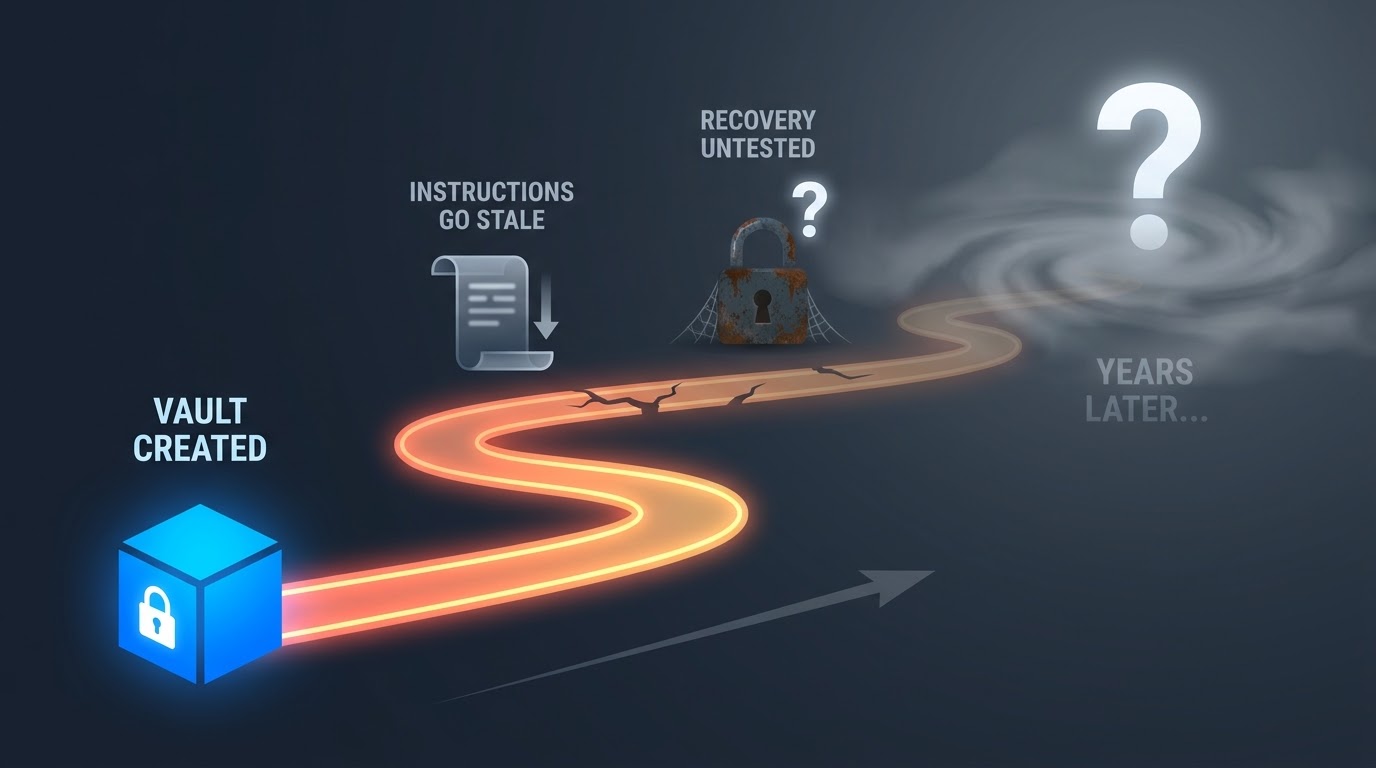
None of these are exotic. They are the default outcome of doing nothing, which is what busy people do with a setup they finished and filed away. Inheritance readiness isn't a document you produce once; it's a state you have to keep a system in. That's the real problem — not the cryptography, the upkeep.
How Keystody helps — today
2-of-3 is not a Keystody invention, and the obvious objection deserves a straight answer: it is also the shape used by the best-known guided multisig services, so an argument for 2-of-3 is an argument for them too. Two things separate the setups. The first is who holds the third key — in those services one of the three sits with the provider; at Keystody all three are yours and the platform holds none. The second is what happens in the years after setup, which is what this article is about.
Keystody is built around exactly that gap: not making a vault, but keeping one worthy of being inherited. A few things it does today, all of them on shipped features:
- A Foundation Checklist walks you through the parts people skip — backing up the descriptor, confirming each key's seed backup, distributing keys geographically, naming emergency contacts, running a recovery test, and documenting an inheritance plan. The vault works regardless; the checklist makes sure the survivable version gets built.
- A health grade, A to F, turns "is this still in good shape?" into something you can see at a glance, and it surfaces verifications that have gone overdue when you sign in — so a setup that's drifting doesn't drift silently.
- Descriptor and recovery-document export means your family is never locked into Keystody — provided you actually export. The descriptor is the blueprint that binds your three keys into one wallet, and it cannot be reconstructed from the seeds: holding two seeds does not tell you the third participant's public key. Heirs with two of three keys and no descriptor are stuck. Export it, keep a copy somewhere that isn't Keystody, and the wallet can be rebuilt in independent, industry-standard software like Sparrow, Bitcoin Core, or any wallet that imports output descriptors. Do that, and if Keystody disappeared tomorrow your heirs could still recover the funds with two keys and your instructions. Skip it, and the no-lock-in claim isn't true for you. That is precisely why the descriptor backup is the first item on the Foundation Checklist and not a footnote.
And the foundation under all of it: Keystody never holds any of your keys. Not one. The platform cannot move your Bitcoin and cannot freeze it — there is no key here to sign with, and nothing on-chain that Keystody controls. The honest boundary is elsewhere: Keystody can become unavailable — an outage, a lapsed subscription, a business that doesn't make it. That wouldn't touch your coins, but it would remove the coordination layer you'd been using to move them, which is the second reason the exported descriptor isn't optional. Your family controls the vault, start to finish. Keystody holds the discipline around it, not the keys to it.
The honest part. Self-custody means the responsibility is yours — that is the trade you're making, and no software erases it. You are trading counterparty risk for operational work, and the work is real: you have to choose who holds a key, write down how recovery works, and keep the plan current as life changes. Keystody makes that manageable and hard to forget. It does not make it automatic.
Where this leaves you
The public debate Kathmann is raising is the right one, and its uncomfortable core is simple: the assets that are hardest to inherit are the ones no institution is holding for you. If you have decided to hold your Bitcoin yourself, the work that follows is to build a setup that no single accident — and no single person — can break, and then to keep that setup alive long enough to actually be inherited.
That is what a 2-of-3 family vault, maintained over time, is for.
If you're holding Bitcoin for the long run and you've been putting off the inheritance question, that's the normal place to be — it's a question with no comfortable DIY answer, which is exactly why most people leave it unanswered. You can see how Keystody approaches it at keystody.com. I also offer a free 30-minute setup call to talk through your situation — no pitch, just a conversation about what a durable, inheritable setup would look like for you.